
All companies require risk management, but do we understand what is the risk management process? This article explains a concise, repeatable risk management process built around six practical questions.
Risk Management Process: 6 Questions to Ask
The process of risk management becomes very simple and intuitive when we follow the six questions to ask below.
1. What am I trying to achieve? (Objective setting)
Every effective risk process starts with clarity on objectives. Risk is defined as uncertainty that affects objectives — so if objectives are vague, risk management will be vague too.
Practical steps
- List objectives at each level: strategic (3–5 years), tactical (annual plans), and operational (team or project).
- Make objectives measurable where possible (KPI targets, milestone dates, budget limits).
- Define scope: which part of the organisation or which project the risk process covers.
- Identify stakeholders and decision-makers who will approve risk responses.
Why this matters
Clear objectives sharpen the lens through which risks are identified and assessed. For example, a delivery project’s top risk might be “supplier delay affects go-live date” when the objective is time-bound, but something else when the objective is quality.
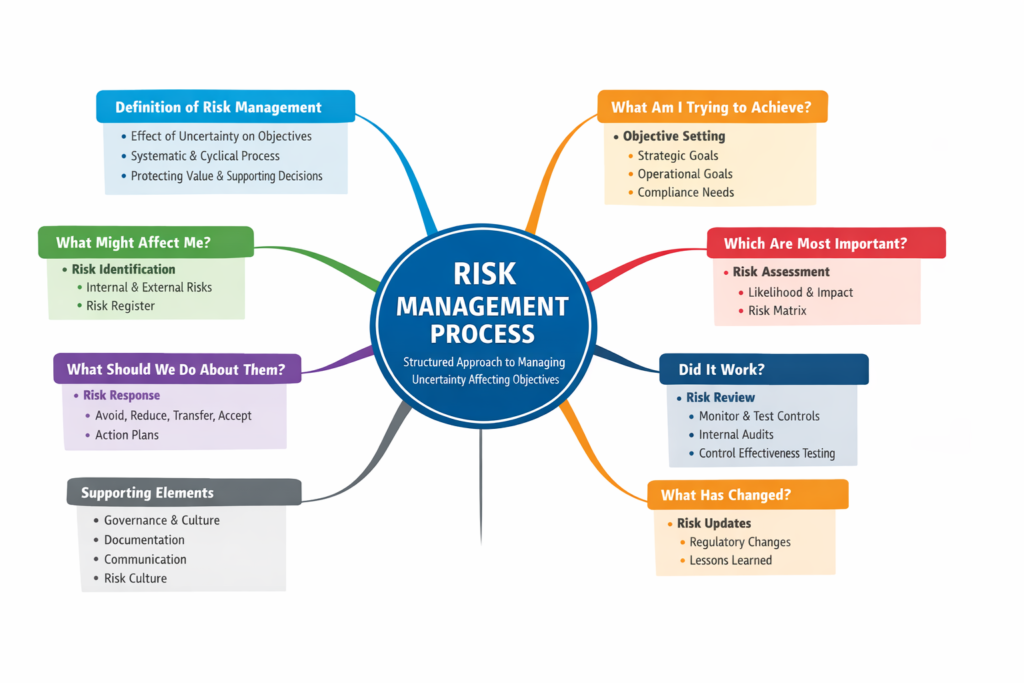
2. What might affect me? (Risk identification)
This step builds the raw material: the list of things that could help or hinder your objectives.
Common sources of risk
- Internal: staffing, processes, IT systems, budgets, governance.
- External: market shifts, regulation changes, supply chain, natural hazards.
- Emerging: new technology disruption, geopolitical shifts, social trends.
Techniques to identify risks
- Brainstorming workshops with cross-functional teams.
- SWOT analysis focused on threats and weaknesses.
- Review of past incidents, near misses, and audit findings.
- Stakeholder interviews and supplier risk questionnaires.
- Environmental scanning and regulatory horizon scanning.
Output: a risk register
Capture each risk with a clear title, short description, affected objective, and initial owner. Even low-confidence or “speculative” risks deserve recording; they may become important later.
3. Which of these are most important? (Risk assessment)
Not all risks should get the same attention. Risk assessment helps prioritise effort where it matters most.
Assessment criteria
- Likelihood: how probable is the event? Use qualitative terms (rare, unlikely, possible, likely, almost certain) or numeric probabilities for advanced users.
- Impact: what is the consequence on objectives (financial, operational, reputational, safety, legal)?
- Speed of onset: will the impact be immediate or slow-building?
- Detectability: how likely are we to spot the issue before it becomes critical?
Tools and outputs
- Risk matrix and heat map to visualise high-probability, high-impact risks.
- Quantitative modelling (expected monetary value, Monte Carlo) for financial decisions.
- Prioritised list and identification of critical risks that require immediate action.
Practical tip
Keep assessment simple enough to be repeatable. Many organisations overcomplicate scoring and then fail to update it.
4. What should we do about the most important ones? (Risk response development)
After prioritising, design how you will treat each critical risk.
Four standard responses
- Avoid: stop the activity that creates the risk. Use this for unacceptable exposures.
- Reduce: put controls in place to lower likelihood or impact (process changes, training, technology).
- Transfer: shift risk to another party (insurance, supplier contracts, guarantees).
- Accept: formally accept residual risk when cost of treatment outweighs benefit, but monitor it.
Building an action plan
- Define specific actions, deadlines, and measurable targets for each control.
- Assign a risk owner with authority and resources.
- Specify key risk indicators (KRIs) and monitoring frequency.
- Record cost and expected benefit to support prioritisation.
Control types
- Preventive: stop the risk from occurring (access controls, supplier vetting).
- Detective: identify the risk early (monitoring, alerts, inspections).
- Corrective: restore systems or processes after an incident (business continuity, contingency plans).
Make it operational
Embed responsibilities into performance plans and meeting cadences. Without accountability, well-crafted responses become forgotten tasks.
5. Did it work? (Risk review)
Controls and mitigation plans must be tested and reviewed. Monitoring turns static plans into living protection.
Monitoring methods
- KPIs and KRIs tied to objectives (e.g., on-time delivery rate, supplier lead-time variance).
- Regular risk reviews in management meetings.
- Internal audits and control testing.
- Incident and near-miss reporting with root cause analysis.
Review questions to ask
- Has the likelihood or impact changed?
- Are controls operating as intended?
- Are risk owners following the agreed action plan?
- What new evidence (incidents, external signals) should update our assessment?
Reporting
Produce concise dashboards for leadership showing top risks, trend arrows (improving/worsening), and overdue actions. Transparency builds trust and supports faster decisions.
6. What has changed? (Risk updates and lessons learned)
Risk environments evolve. Updating the register and learning from events are essential for resilience.
Triggers for updates
- Business model changes, new products, mergers.
- Regulatory shifts and industry guidance.
- External events: supply disruption, market shock, natural disaster.
- Near misses or incidents revealing control weaknesses.
Learning loop
- After an incident, run a structured post-incident review (what happened, why, what worked, what failed).
- Capture lessons and convert them into concrete changes: new controls, training, process updates.
- Communicate lessons across teams and update documentation.
Continuous improvement
Treat risk management as cyclical, not a once-off project. A mature programme uses past evidence to refine assessment criteria, adjust KRIs, and reallocate resources toward the most effective controls.
Implementation checklist (quick practical guide)
- Define objectives and scope.
- Populate a risk register and assign owners.
- Run a cross-functional risk identification workshop.
- Score risks for likelihood and impact; produce a heat map.
- Build response plans for critical risks and assign clear owners and deadlines.
- Set KRIs and monitoring frequency.
- Hold monthly or quarterly risk review meetings.
- Conduct post-incident reviews and update the register.
- Keep the register accessible and version-controlled.
FAQs
Conclusion
A good risk management process is simple, repeatable, and tied directly to objectives. By answering the six questions organisations can move from ad hoc firefighting to proactive resilience. Start with a clear objective, build a light but disciplined risk register, assign owners, and make review a habit. Over time, you will spend less time reacting and more time steering with confidence.